


This dog feeding chart shows how much a typical adult dog should eat each day by weight, in calories and in cups of dry food, with room left for treats. Start with the number for your dog’s weight, check it against the calories on your food’s label, then fine-tune by watching your dog’s body shape.
Feed by calories, not by the scoop. Needs depend on weight, age, activity and neuter status, and foods vary widely in calories per cup. Use the chart as a starting point, weigh portions if you can, and check body condition every two to four weeks.
This chart covers a typical adult dog. For your own dog’s weight, age, activity and the calories in your food, use our free dog calorie calculator. It turns the result into cups or grams per meal.
Table of Contents
How We Built This Feeding Chart
The chart uses the two-step method in veterinary references such as this Pet Nutrition Alliance guide:
- Resting energy (RER): 70 × body weight in kg0.75.
- Daily needs: RER × a life-stage factor: 1.6 for a neutered adult, 1.8 intact, 1.0 for weight loss (at ideal weight), 2 to 3 for puppies.
We then set aside 10% for treats and divided the rest by typical calories per cup. Individual dogs can differ widely from the prediction, so the steps below matter as much as the number.

Dog Feeding Chart by Weight
Estimates for a typical neutered adult after setting aside 10% for treats:
| Dog’s Weight | Est. Daily Calories | Treat Budget (10%) | Cups/Day at 350 kcal/cup | Cups/Day at 400 kcal/cup |
|---|---|---|---|---|
| 5 lb (2.3 kg) | ~205 kcal | ~20 kcal | ~0.5 | ~0.5 |
| 10 lb (4.5 kg) | ~350 kcal | ~35 kcal | ~0.9 | ~0.8 |
| 20 lb (9.1 kg) | ~585 kcal | ~60 kcal | ~1.5 | ~1.3 |
| 30 lb (13.6 kg) | ~795 kcal | ~80 kcal | ~2.0 | ~1.8 |
| 40 lb (18.1 kg) | ~985 kcal | ~100 kcal | ~2.5 | ~2.2 |
| 50 lb (22.7 kg) | ~1,165 kcal | ~115 kcal | ~3.0 | ~2.6 |
| 60 lb (27.2 kg) | ~1,335 kcal | ~135 kcal | ~3.4 | ~3.0 |
| 70 lb (31.8 kg) | ~1,500 kcal | ~150 kcal | ~3.9 | ~3.4 |
| 80 lb (36.3 kg) | ~1,655 kcal | ~165 kcal | ~4.3 | ~3.7 |
| 100 lb (45.4 kg) | ~1,960 kcal | ~195 kcal | ~5.0 | ~4.4 |
Our estimates: 70 × kg0.75 × 1.6, level 8-oz cups. Less active dogs often need about 20% less.
How to Find the Calories in Your Dog’s Food
Look for the calorie statement near the guaranteed analysis, such as “3,650 kcal/kg, 380 kcal/cup.” AAFCO’s label guide shows where it is.
- Dry food: kcal per cup, or per kg if you weigh.
- Canned food: kcal per can.
- Fresh or homemade: kcal per kg. See fresh food for dogs.
- Mixing foods: split calories (say 75% dry, 25% wet) and work out each share separately.
Switching brands without recalculating is an easy way to overfeed.
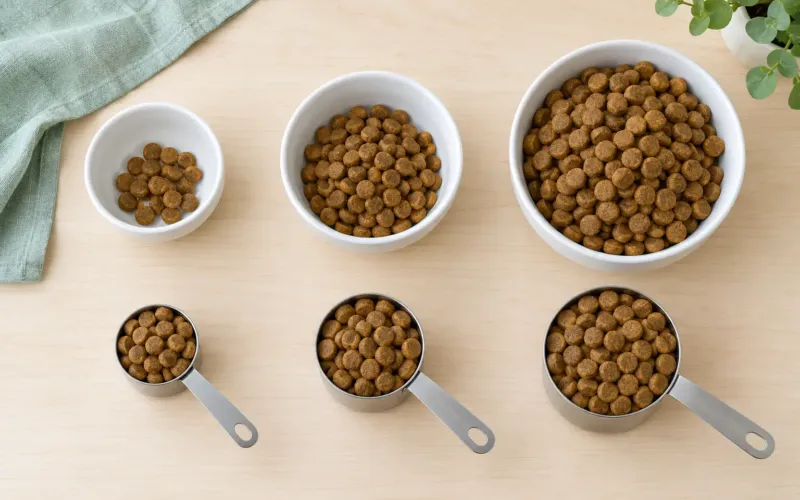
Why Weighing Beats Scooping
In a University of Guelph study, owners measuring kibble with common scoops were off by 48% too little to 152% too much. A cheap kitchen scale fixes that: use the kcal/kg number on the label to work out grams instead of cups.
Adjust Using Your Dog’s Body Condition
Vets score body shape on a 9-point scale where 4 or 5 is ideal: ribs easy to feel, visible waist. Cornell’s Riney Canine Health Center notes each point above ideal is roughly 10% of current weight.
| Body Condition | What You See and Feel | What to Do |
|---|---|---|
| 1-3: Too thin | Ribs, spine or hips easy to see | See your vet before adding food. |
| 4-5: Ideal | Ribs easy to feel, clear waist | Keep the amount; recheck monthly. |
| 6-7: Overweight | Ribs hard to feel, faint waist | Ask your vet about a plan based on ideal weight. |
| 8-9: Obese | No ribs felt, fat over back | Follow a vet-supervised plan. |
Worked example: a 60-lb dog scored 7 is two points over, so its ideal weight is about 60 − (2 × 10% × 60) = 48 lb. Cornell advises losing 1 to 2% of body weight a week, here about half a pound to a pound. At ideal weight, adjust by about 10% if your dog slowly drifts.
Puppies, Seniors and Active Dogs
- Puppies: need about two to three times RER, easing after four months. Weigh every week or two and keep them lean; fast growth stresses large-breed joints.
- Seniors: many need fewer calories (try “less active”), but very old dogs losing muscle may need more.
- Working dogs: can need far more than “very active”; increase gradually.
Treats, Toppers and Meals
Treats, chews, toppers and scraps all count; keep them under about 10% of daily calories. Our dog food toppers guide lists calories per spoonful, and ground turkey for dogs has a topper chart. Most adults do well on two meals a day, puppies on three to four.
How Much to Feed: Quick Guide
✓ Do
- Use the calories printed on your food
- Weigh portions or use a level 1-cup measure
- Count treats and toppers in the total
- Recheck body condition every few weeks
✕ Don’t
- Switch foods without recalculating
- Feed by eye or with a heaped scoop
- Cut food sharply to speed up weight loss
- Treat the number as exact for every dog
Every dog is different. Puppies, pregnant dogs and dogs with health conditions should follow a feeding plan from their vet.
Frequently Asked Questions
How much should I feed my dog a day?
A 30-lb neutered adult needs about 795 kcal, or around 2 cups of a 380 kcal/cup food. Use the chart above, or our calorie calculator for an exact number.
Is the feeding guide on the bag accurate?
It’s a starting range. Many less active dogs need less; body condition is the final judge.
How many cups of food should a 50 lb dog eat?
About 2.5 to 3 cups of a 350 to 400 kcal/cup food for a neutered adult, after treats.
Should I feed my dog based on current or ideal weight?
Current weight if your dog is lean; ideal weight, set with your vet, if overweight.
Does this feeding chart work for homemade food?
Use the calorie column only, since the cups assume dry kibble. The chart can’t check whether a recipe is balanced. See our homemade dog food recipes.
Explore more in the complete dog food guide.
The Bottom Line
The right amount comes from your dog’s weight, a life-stage factor and your food’s calories. This dog feeding chart gives you a quick starting point, our dog calorie calculator personalizes it, and body shape has the final say. Weigh portions, count treats and involve your vet for puppies, weight loss or health problems. Explore our Dog Food section for more. This article is general information, not veterinary advice; see our Veterinary Disclaimer.
References & Sources
Written by CPD Nutrition Desk using the sources below. We are not affiliated with these organizations, and this guide is not a substitute for advice from your veterinarian.
- Pet Nutrition Alliance — Pet Nutrition Alliance guide
- AAFCO — AAFCO's label guide
- news.uoguelph.ca — University of Guelph study
- vet.cornell.edu — Cornell's Riney Canine Health Center