

Natural dog chews are single-ingredient chews made from real food, such as dried sweet potato, fish skin, bully sticks or cow ears, instead of synthetic or heavily processed materials. You can make two of the safest ones at home: thick sweet potato chews and crunchy salmon skin strips. Whatever you choose, pick the right size and hardness, and always supervise chewing.
Prep: 15 minutes. Cook: 3 to 6 hours low and slow in the oven or a dehydrator. Yield: about 24 sweet potato chews or 10 salmon skin strips. Difficulty: easy. Storage: airtight container, 2 weeks in the fridge or 3 months frozen.

Table of Contents
What Are Natural Dog Chews?
There's no official definition for chews, but most people mean single-ingredient, minimally processed animal or plant parts with no artificial colors, flavors or preservatives. Natural doesn't automatically mean safe. Some natural chews are too hard for teeth, some are high in calories, and some carry bacteria risks.
Natural Chews Compared
| Chew | Hardness | Calories | Main cautions |
|---|---|---|---|
| Dried sweet potato | Soft to medium | about 20 to 25 per chew | Choking if swallowed whole; mold if not dried fully |
| Salmon or fish skin | Medium, crunchy | about 30 to 50 per strip (estimate) | Fatty; introduce slowly |
| Bully sticks | Medium | about 9 to 22 per inch | Calories add up; swallowing the end piece |
| Cow ears | Medium | Moderate | Fat varies |
| Pig ears | Medium | Often high | Fatty; past Salmonella recalls |
| Yak or hard cheese chews | Very hard | High | Can crack teeth |
| Antlers and real bones | Very hard | Low to moderate | Tooth fractures; bones splinter |
A widely used vet rule: if you can't press a fingernail into a chew, it's probably too hard for your dog's teeth. Bully stick calorie range from published analysis of retail bully sticks.
Are natural dog chews safe for every dog?
Not every chew suits every mouth. Our can dogs have rib bones guide explains why cooked bones are never a safe chew.
Recipe 1: Thick Sweet Potato Chews
Cutting slices thick (about 1/2 inch) gives a chewier, longer-lasting result than thin chips. See can dogs eat sweet potatoes for the nutrition side.
Thick Sweet Potato Dog Chews
Ingredients
Method
- Heat the oven to 225 F or set a dehydrator to 135 F.
- Scrub the sweet potatoes. Peeling is optional.
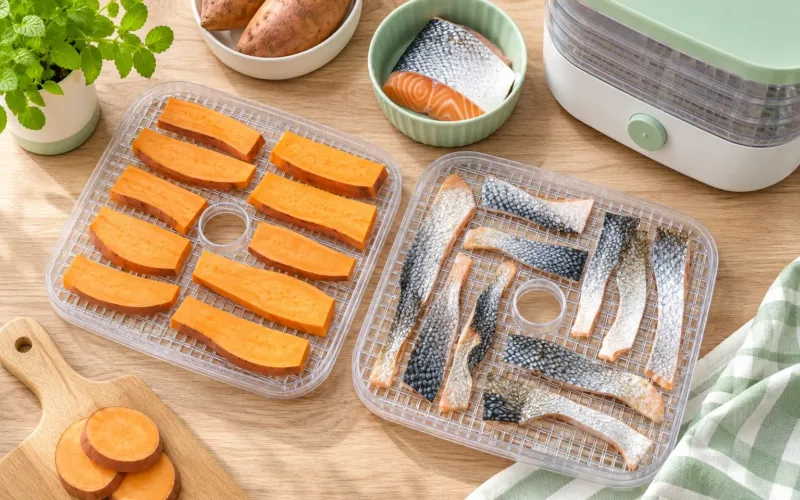
- Cut lengthwise into planks about 1/2 inch thick.
- Lay on a parchment-lined tray or dehydrator racks without touching.
- Bake 3 to 4 hours (or dehydrate 8 to 10 hours), turning halfway, until leathery and dry with no moist center.
- Cool completely before storing or serving.
Notes
Recipe 2: Crunchy Salmon Skin Strips
Salmon skin is rich in omega-3 fats and makes a crunchy chew. Use skin from fresh, unseasoned fillets. See can dogs eat salmon.
Crunchy Salmon Skin Dog Chews
Ingredients
Method
- Heat the oven to 275 F. Scrape off any scales and leftover flesh, rinse and pat very dry.
- Cut the skin into strips about 1 inch wide.
- Lay strips flat on a parchment-lined tray, shiny side down.
- Bake 20 minutes, then lower the oven to 200 F and bake 1 1/2 to 2 hours more until fully crisp and brittle.
- Cool completely. Strips should snap, not bend.
Notes
How Many Natural Chews Per Day?
Chews count as treats. Keep the total under about 10 percent of daily calories.
| Dog weight | Approx. daily calories | Sweet potato chews (about 22 kcal) | Salmon skin strips (about 40 kcal) |
|---|---|---|---|
| 10 lb | about 350 | 1 | 1/2 strip |
| 25 lb | about 690 | 2 to 3 | 1 |
| 50 lb | about 1,160 | 3 to 5 | 1 to 2 |
| 75 lb | about 1,580 | 5 to 7 | 2 to 3 |
Estimates based on USDA FoodData Central values; daily calories use 70 x kg^0.75 x 1.6. Don't give the full amount of both on the same day.
Safe Chewing Rules
- Choose a size your dog can't swallow whole: longer than the width of your dog's muzzle.
- Supervise every chew session and take away the last small piece.
- Introduce new chews slowly to avoid stomach upset.
- Skip very hard chews for puppies, seniors and dogs with dental work.
- Wash hands after handling raw fish skin and animal chews.

Do Natural Chews Clean Teeth?
Chewing can scrape off some plaque, but natural chews aren't tested for dental benefits. If teeth are the goal, look for products with the Veterinary Oral Health Council (VOHC) seal, and brush when you can. Read dog bad breath for more.
Stop and call your vet if your dog swallows a large piece, gags, vomits repeatedly, strains to poop or seems painful after a chew. Broken teeth also need a vet visit.
Which chews do you consider safest, and which break teeth? Softer chews you can dent with a fingernail and products with the VOHC seal are the safest. Antlers, hooves, hard bones and nylon bones are the ones I see break teeth most.
What chew-related emergencies do you see most often? Broken teeth, pieces stuck in the throat or intestines, and cooked bones splintering. Always supervise and take the chew away when it gets small enough to swallow.
— Dr. Sarah Miller, DVM
Safe chewing
✓ Do
- Pick the right size
- Supervise every session
- Use the fingernail test
- Count chew calories
✕ Don't
- Cooked bones
- Very hard antlers
- Leaving the last small piece
- Chews with mold
Keep treats under about 10% of daily calories.
Frequently Asked Questions
What are the safest natural chews for dogs?
Softer, digestible chews sized correctly: thick dried sweet potato, fish skin strips and bully sticks for most dogs, always supervised.
Are natural chews safe for puppies?
Soft options like sweet potato chews are fine for older puppies under supervision. Avoid hard chews while adult teeth are coming in.
Are antlers good for dogs?
Many vets advise against them because they are hard enough to fracture teeth.
How long do homemade natural chews last?
Fully dried chews last about 2 weeks in an airtight container in the fridge, or 3 months frozen. Throw away any with mold or a soft, damp center.
Are rawhides natural chews?
Rawhide is made from hide, but it is heavily processed and can swell or cause blockages. Many owners prefer the options above.
The Bottom Line
Natural dog chews are best when they're simple, digestible and the right size. Homemade thick sweet potato chews and salmon skin strips are easy wins; count their calories, skip very hard chews, and supervise every session.
References & Sources
Written by CPD Nutrition Desk using the sources below. We are not affiliated with these organizations, and this guide is not a substitute for advice from your veterinarian.
- USDA — USDA FoodData Central
- vohc.org — Veterinary Oral Health Council (VOHC)